
FlowStop.
Inflate. Protect.
Pack away.
An inflatable flood barrier for suitable openings. Permanent posts or rails aren’t needed where the opening and support arrangement allow it.
Made to measure. Reusable. Assessed for your opening.
Wider openings and some surfaces need additional support or preparation.
FlowStop – supplied in New Zealand by
Special Solutions Flood Protection

How to set up FlowStop
Official manufacturer demonstration. Open the video on YouTube. Demonstration footage is not a guarantee of deployment time or performance at your site.
Prefer a quick written explanation?
FlowStop is positioned in a pre-assessed opening and inflated in the sequence specified in its manual. Its chambers press the seals against the jambs and threshold. Check the fit and pressure, including any specified supports. When it is safe to remove, deflate, clean, dry and store it. Practise before a flood warning and follow the instructions for the model supplied.
How the pressure seal works
When it’s safe to remove the barrier, deflate it and store it away.
FlowStop is an inflatable flood barrier made for a particular opening. Its two chambers and perimeter seals work together to press against suitable side surfaces and the floor or threshold.
What changes compared with aluminium barriers?
A conventional removable aluminium system usually has side posts or channels fitted in advance. FlowStop can avoid those permanent side fittings where the opening, support and sealing surfaces are suitable.
Check the frame, threshold, clearances and expected water conditions before choosing FlowStop.
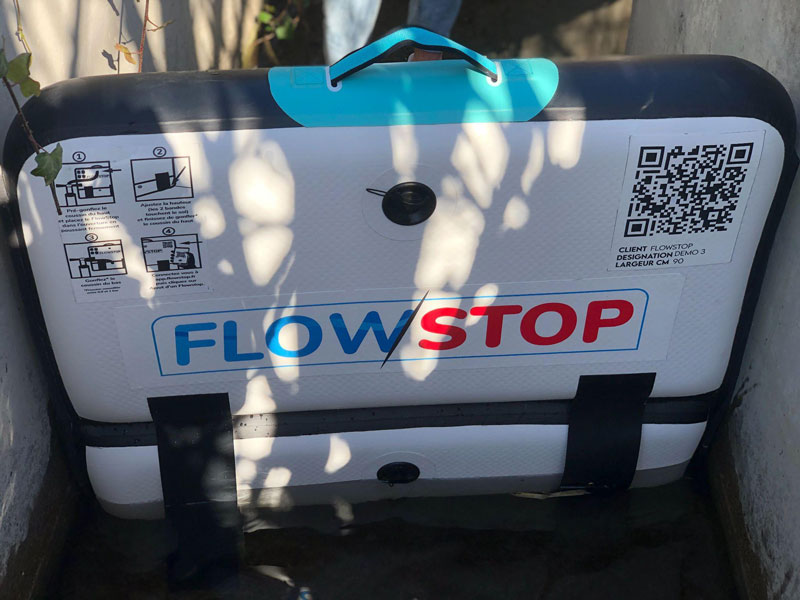
Fitting, removing and storing FlowStop
Prepare the opening
Before a flood: confirm the fit, remove debris and check the contact surfaces, access route and any required supports.
Position the barrier
Place the correct, labelled barrier in its assessed opening. Check clearance around handles, tracks, stops and other obstacles.
Inflate and check
Follow the supplied inflation sequence and pressure instructions. Fit required supports and check the seals before water arrives.
Remove and store
When conditions are safe, deflate, clean, dry and pack away. Inspect the barrier and keep it with its pump and instructions.
This is an overview, not a substitute for the model-specific manual. Deploy early, keep a safe exit route and follow official emergency advice. Do not enter floodwater to install or adjust a barrier.
Product height is not protection height.
The effective seal sits below the top of the product. We use the conservative figures below when starting a suitability review.
800 mm overall
1,000 mm overall
| Model | Opening width guide | Overall height | Effective sealing height | Approx. weight |
|---|---|---|---|---|
| S | Up to about 1.2 m | 800 mm | ≈ 700 mm | ≈ 4 kg |
| M | Over 1.2 m to 2 m | 800 mm | ≈ 700 mm | ≈ 7 kg |
| L | Over 2 m to 3 m | 1,000 mm | ≈ 900 mm | ≈ 12 kg |
| XL | Over 3 m to 4.5 m | 1,000 mm | ≈ 900 mm | ≈ 15 kg |
Manufacturer size bands and weights are indicative; exact dimensions, boundary sizes, support needs and the quoted configuration must be confirmed before manufacture. All dimensions shown are metric.
What if my opening is at a size boundary or wider than 4.5 m?
Send the measurements and photographs to SSFP. We will confirm the current model, height and support arrangement with FlowStop before quoting. Do not order from the indicative bands alone, or assume a larger opening can be protected without anchoring.
Choose your FlowStop size.
FlowStop is made to measure. Choose a size to see the starting price, then request a fit and delivery check. We’ll confirm the exact fit, estimated delivery time and full NZ delivered price before you pay by bank transfer.
Small
Up to about 1.2 m
From NZ$1,895 incl. GST
View SmallMedium
Over 1.2 m to 2 m
From NZ$3,210 incl. GST
View MediumLarge
Over 2 m to 3 m
From NZ$4,090 incl. GST
View LargeExtra Large
Over 3 m to 4.5 m
From NZ$5,830 incl. GST
View Extra LargeWidths are a guide. Openings over 2 m need a support and anchoring review. Orders are placed after your bank transfer clears.
Will FlowStop fit my opening?
Photos and approximate measurements are a useful first step. Final manufacturing measurements and installation requirements are confirmed separately.
- Opening widthClear measurements at the threshold and proposed barrier height, including changes across the contact depth.
- Jamb conditionSound sides able to withstand the pressure; loose finishes or flexible cladding need further review.
- Available contact depthEnough unobstructed depth for the specified model, on both sides and along the bottom.
- Surface typeCheck texture, joints and friction. Smooth aluminium or painted surfaces may need non-slip treatment.
- Obstacles and accessHandles, tracks, door stops and projecting cat doors must not interrupt the seal. Maintain a safe exit.
- Threshold and surrounding areaCheck steps, slopes, cracks, drains and uneven floors, plus bypass routes through walls and other openings.
- Width and water-related supportConfirm closed-door backing, straps or anchors where required; depth and width both affect the arrangement.
For everyday places worth preparing.


These are manufacturer application examples, not SSFP installation case studies or proof that a particular New Zealand building is suitable.
Pack away the barrier. Keep the plan ready.
Once the flood risk has safely passed
Remove the barrier following its manual, clean off contamination, inspect the seals and allow it to dry before storage. It can be deflated and rolled, or stored slightly inflated where space allows.
Keep it indoors, dry and away from direct sunlight and heat. Store the pump and instructions together, label each barrier for its opening, and practise deployment before you need it.
The manufacturer’s storage conditions apply. Confirm packaging and storage space for the exact size in your quotation.

A practical part of your flood-response plan.
For councils, emergency management teams, schools, facilities managers, commercial property owners and community organisations, start with the openings that matter most.
SSFP is your New Zealand contact for product assessment, available technical information, quotations and support. Site visits are available by arrangement; remote reviews can begin with photos and measurements.
For multi-site enquiries, include the number of openings, locations, deployment team and procurement requirements.
Rapid deployment
Build a practised setup procedure into your response plan, with clear warning triggers and assigned roles.
Reusable protection
Plan inspection, cleaning, drying and storage so the equipment is ready for the next event.
Minimal permanent impact
Suitable openings may avoid permanent side posts and rails. Check support and surface needs first.
Compact storage
Keep labelled barriers, pumps and instructions accessible near the intended deployment locations.
Evidence for review
Request the manufacturer’s documents and relevant independent research for the proposed configuration.
Local point of contact
Enquiries, product guidance and supply discussions remain with Special Solutions Flood Protection.
Behind the FlowStop barrier.
Explore the factory video supplied by FlowStop. Product appearance and supplied accessories can vary; your quotation confirms the configuration for your opening.
Watch FlowStop’s factory video on YouTube ↗. Manufacturer media used with permission.
Tests and supporting information
National Research Council Canada
Technical report · revision 1.6 · 2 July 2025NRC research examined temporary opening barriers, including FlowStop configurations, under specified test conditions. Its results are useful evidence for the configurations tested.
They are not blanket certification of every current FlowStop model, all widths or any individual building. The report records both promising performance and limitations; matching the product and site to the relevant evidence matters.
Check the proposed configuration
Ask us for the current manufacturer instructions, dimensions, sealing-height information, support requirements and available test documentation for your intended opening.
We distinguish independent research, manufacturer statements and the information still needed about your site. Product guidance is not structural engineering, hydrological design or a guarantee that the whole building will stay dry.
Your questions, answered.
Does FlowStop need permanent rails?
No permanent side rails, posts or channels are needed in suitable installations. The opening must provide suitable sealing surfaces and support. Some installations need non-slip strips or other preparation, and openings over 2 m need a specific support and anchoring review.
How quickly can it be deployed?
The manufacturer demonstrates deployment in minutes. Actual setup time depends on size, access, supports, the pump and the operator’s practice. We do not promise a fixed time for every installation. Prepare and practise before flooding is forecast.
Can one person install it?
A smaller barrier may be manageable by one trained person. Size, weight, reach, access and any required supports determine the safe deployment method. Larger models may need assistance; agree a practical plan for the people who will use it.
What widths are available?
FlowStop is made to measure. The comparison above covers the standard S–XL range up to about 4.5 m. Ask us about exact boundary sizes and larger or unusual openings before specifying a model.
What flood depth can it protect against?
For initial reviews, we use approximately 700 mm effective sealing height for an 800 mm model, and 900 mm for a 1,000 mm model. These are sealing heights, not universal safe flood-depth ratings. Support, waves, structure and other water-entry paths must also be considered.
Can it be used with aluminium frames?
Potentially, if the frame is sufficiently rigid and has suitable contact surfaces and depth. Smooth aluminium can need non-slip strips; flexible framing or cladding may be unsuitable. Send close-up photos and dimensions so we can check the arrangement.
Does anything remain attached after removal?
In a suitable pressure-fit installation without preparation or anchoring, the barrier is removed and stored away. Where non-slip strips, anchors or other measures are specified, those may remain. We will identify the proposed arrangement before you order.
Can it be reused?
Yes. Inspect, clean, dry and store it in line with the supplied instructions. Reuse depends on condition: damage to chambers, seals or valves needs checking before another deployment.
How is it stored?
Deflated and rolled, or slightly inflated if space permits. Store indoors in a dry place away from direct sunlight and heat, with the pump and instructions nearby. Follow the manufacturer’s model-specific storage limits.
Does it need power?
It can be inflated with a suitable manual pump, so deployment does not require mains electricity. Your quotation will specify the pump and accessories supplied. Use only the pump arrangement and pressure specified in the instructions.
What happens above 2 metres width?
For openings over 2 m, SSFP will check the required support straps and ground anchoring with FlowStop before quoting. Requirements depend on the exact width, water depth and configuration. Do not assume a wider barrier meets a no-drilling or no-permanent-fittings requirement.
Can SSFP assess my doorway?
Yes. We can begin with your location, photographs, approximate measurements and known flood history. Site visits are available by arrangement, particularly in Manawatū–Whanganui. Some openings need further manufacturer or specialist assessment before a final recommendation.
What warranty applies?
FlowStop provides a five-year manufacturer warranty from delivery, subject to its installation, use and storage conditions. For warranty enquiries or claims, contact Special Solutions Flood Protection and we will liaise with FlowStop on your behalf. Applicable New Zealand consumer rights are not replaced by a manufacturer warranty.
What is the current lead time?
FlowStop has confirmed a current production estimate of 4–5 weeks, regardless of size. Some stock may be available, subject to an exact size check. Production time is separate from freight and delivery to New Zealand. SSFP will confirm availability and the estimated total lead time in your quotation.
Will this keep all water out of my house?
A barrier protects a defined opening, not every route into a building. Water can enter through walls, weep holes, drains, vents, ground or other openings, or exceed the selected system’s limits. We consider those wider issues when discussing the product with you.
Interested in FlowStop? Talk to Allan.
Leave your name and email and Allan will get in touch. Add a phone number if you would prefer a call, and a comment if you like. No photos or measurements needed to start.
Your contact details
Name and email are required. Phone and comment are optional.
We use your details to respond to your product enquiry.
Start with a conversation.
Leave your contact details and Allan will get in touch.